


Pepper Before Sunrise
The day in a Henan county town does not begin with an alarm clock. It begins with the sound of a ladle against the rim of an aluminum pot, somewhere around five in the morning, in a doorway you might walk past a hundred times without a second look. Step through the steam and there it is: a vat of soup the color of wet bark, thick enough to hold a spoon upright for a second or two, breathing pepper into the cold air.
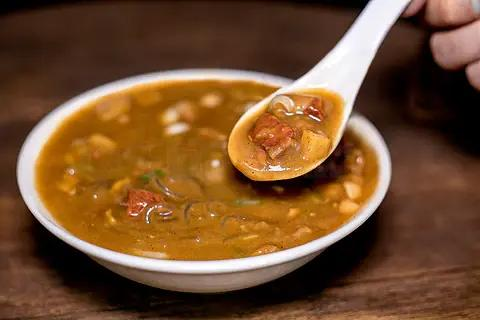
The soup is hú là tāng (胡辣汤). The name is usually rendered as “pepper splash soup,” which sounds odd in English and is, frankly, odd in Chinese too. Nobody eats it for elegance. You eat it because the morning is cold, because you have to be at work by seven, because your father ate it standing in this same alley thirty years ago.
Here is what surprises visitors: the heat does not come from chili. It comes from black pepper, a great deal of it, ground fresh into the pot. Chili is available on every table in a small dish of red oil, and most regulars leave it alone. Black pepper arrived in China by trade route centuries before the chili did, and in the cooking of Henan it never really left. The heat it gives is different — a slow warmth that starts in the throat and moves outward, that makes the nose run and the shoulders drop. It is warmth as much as spice.
Ask three vendors where the soup comes from and you will get two answers and an argument. The towns of Xiaoyao (逍遥镇) and Beiwudu (北舞渡) lie a hundred-odd kilometers apart, and both are certain the dish was born on their streets. Xiaoyao’s version runs thinner, more broth, the spice list brighter and more floral. Beiwudu’s is heavier, almost a stew, with more meat per bowl than seems reasonable before breakfast. The stories both towns tell are grand: a recipe that slipped out of a Song dynasty kitchen, a court chef fleeing south with nothing but a sack of spices. None of it can be proven, which suits everyone fine. The soup is older than the paperwork, and both towns are right enough.
What can be described is the work. The night before, beef bones go into the pot and stay there. The strange part is the flour. The cook kneads a soft dough, then washes it under water until the starch milks away and what remains between his hands is a lump of gluten, smooth and elastic and faintly sad-looking. He tears it into small pieces and drops them into the broth, and the starchy water goes in too. That is what thickens the soup, which is why a proper hú là tāng clings to the spoon instead of running off it. Into the same pot go sweet potato vermicelli, peanuts, wood-ear fungus, golden day lilies, slivers of beef. The pepper blend is the vendor’s own, a dozen spices or more, and nobody writes it down.
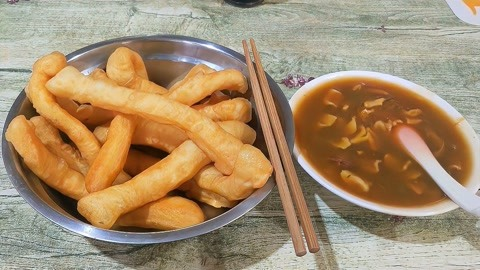
Then the ritual, which is the part no recipe captures. You do not sit down so much as perch on a red plastic stool. The bowl arrives scalding, dark, crowded. Around you: a mason in dusty clothes, a schoolkid with a backpack, a man in a good coat checking his phone. A bowl costs a few yuan, so the soup makes no distinctions, which may be why the town stays loyal to it. You drink from the edge of the bowl, in small sips, until your mouth learns the temperature. Alongside comes a plate of yóumótóu (油馍头), small fried dough puffs, crisp outside and pillowy within, and this is the part that matters: you dunk them. The dough drinks the soup. The soup softens the dough. Somewhere around the third puff you stop thinking about the cold.
If you cannot commit, there is a compromise called liǎng chān (两掺): half pepper soup, half soft tofu pudding, ladled gently into the same bowl. It is smoother and milder, and the regulars treat it the way experienced drinkers treat a shandy. Order it twice, though, and you will find yourself drifting toward the real thing.
I keep thinking about why this soup survives in a country that rebuilds itself every ten years. It is not nostalgia. The people lined up at six in the morning are not being quaint; they are being efficient. The soup does exactly one thing and has never pretended otherwise: it puts warmth into a body on a cold morning, for pocket change, and it does not vary. By eight the pot is scraped, the stools are stacked, the buckets are carried inside. Tonight the bones go in again at midnight, and at five the ladle will ring out against the rim, and the town will wake up to eat.